[Oops: in Act I, I incorrectly identified Ted Olson's wife as Susan Olson, rather than Barbara Olson. I think Susan Olson was actually Cindy Brady, sister of Marcia, Jan, Greg, Peter and Bobby. As far as I know, she was never married to a reactionary member of the Bush team.]
Act II
Theories proposing that something other than Flight 77 was responsible for the damage done to the Pentagon on September 11, 2001 have been harshly criticized in some quarters. Two of the most frequent criticisms that I have read are: (1) the researchers promoting such theories have never been to the D.C. area to view the crime scene, so they don't really know what they're talking about; and (2) promoting such theories can only serve to alienate people in the D.C. area, since so many of them allegedly saw the errant aircraft.
I don't find either of these criticisms particularly valid. Millions of people, after all, have never visited Dallas to stand in Dealey Plaza, but they have still been able to objectively review the evidence and conclude that the official story of the JFK assassination just doesn't add up. Likewise, millions of people have never visited the Ambassador Hotel in Los Angeles, and yet they have been able to draw conclusions about the RFK assassination after reviewing the evidence. I fail to see why the same rules shouldn't apply to the attack on the Pentagon.
As for the witnesses, there were actually relatively few, and an unusually large percentage of those who lent support to the official story were either career military types or media representatives. Some of the witnesses reported seeing an aircraft much smaller than a 757, possibly even a missile. Mike Walter, for example, told CNN that what he saw "was like a cruise missile with wings, went right there and slammed into the Pentagon. Huge explosion, great ball of fire, smoke started billowing out, and then it was just chaos on the highway."
(http://www.cnn.com/2001/US/09/11/pentagon.terrorism/)
Witness Tom Seibert told the Washington Post that he "heard what sounded like a missile, then we heard a loud boom." The same Post article revealed that "Ervin Brown, who works at the Pentagon, said he saw pieces of what appeared to be small aircraft on the ground." Needless to say, a Boeing 757 would hardly be considered a "small aircraft." (http://a188.g.akamaitech.net/f/188/920/5m/www.washingtonpost.com/wp-srv/metro/daily/sep01/attack.html)
The Post also spoke to a Steve Patterson, who said that he saw the plane from about 150 yards away, "approaching from the west about 20 feet off the ground." He described the plane as having "the high-pitched squeal of a fighter jet," and he said that it "flew over Arlington cemetery so low that he thought it was going to land on I-385. He said it was flying so fast that he couldn't read any writing on the side." Patterson also said that the aircraft that he saw "appeared to hold about eight to 12 people" -- hardly an aircraft of sufficient size to be a 757. And a bulky 757 is certainly not the type of aircraft that you would expect to be observed approaching the Pentagon "below treetop level," as this one purportedly was.
The UK's Guardian began its initial report on the
Pentagon attack
with the words: "It sounded like a missile at first, the air above
Washington
filled with the terrifying roar of displaced air." One witness
questioned
by the Guardian claimed, strangely enough, that "the blast had
blown
up a helicopter circling overhead." Of course, since no photographic
evidence
of the crash has been produced, there is little hope of either
confirming or disproving
this claim.
(http://www.guardian.co.uk/Archive/Article/0,4273,4254934,00.html)
Yet another witness account of the attack, this one from a
reporter
for Space.Com, reads as
follows: "At that moment I heard a very loud,
quick
whooshing sound that began behind me and stopped suddenly in front of
me
and to my left. In fractions of a second I heard the impact and an
explosion.
The next thing I saw was the fireball. I was convinced it was a
missile.
It came in so fast it sounded nothing like an airplane."
(http://www.space.com/news/rains_september11-1.html)
It also moved nothing like a passenger airplane, at least on radar.
Air traffic controller Danielle O'Brien, who had earlier
that morning
cleared Flight 77 for take-off from Dulles, certainly didn't think it
was
a Boeing 757 that she was tracking on radar as it approached
Washington.
What she initially saw was "an unidentified plane to the southwest of
Dulles,
moving at a very high rate of speed ... I had literally a blip and
nothing
more." O'Brien described her impression of the projectile that she
tracked: "The
speed, the maneuverability,
the way that he turned, we all thought in the radar room, all of us
experienced
air traffic controllers, that that was a military plane. You don't fly
a 757 in that manner. It's unsafe." The consensus opinion among the
controllers, after
tracking some of
the movements of the projectile, was that it "must be a fighter.
This
must be one of our guys sent in, scrambled to patrol our capital, and
to
protect our president." Of the final portion of the aircraft's
destructive
journey, O'Brien has said: "We lost radar contact with that craft. And
we waited. And we waited."
(http://www.abcnews.go.com/sections/2020/2020/2020_011024_atc_feature.html)
The majority of those claiming to have witnessed the event have offered accounts that are said to corroborate the official story. The stories told by these witnesses, however, are wildly contradictory and at times ridiculously implausible, occasionally involving scenarios where the plane drug a wing along the ground, or even turned cartwheels, before slamming into the Pentagon. As is apparent in collections of witness accounts, like the one posted on an 'Urban Legends' website (http://urbanlegends.about.com/library/blflight77w.htm), there is little agreement among the witnesses on the size and type of aircraft, the altitude and stability of the aircraft, the angle of approach, and various other details.
As any student of the law knows, even the most sincere, well intentioned witnesses can be, and frequently are, mistaken about what it was that they witnessed (especially during times of extreme stress). Add to that the fact that there is a virtually unlimited supply of potential 'witnesses' in the D.C. area who aren't so well intentioned, and it begins to look like witness reports may not be the best way to get at the truth of what happened at the Pentagon on September 11, 2001.
Simply put, the photographic evidence, which trumps the contradictory witness statements, does not support the theory that an enormous commercial aircraft smashed into the Pentagon. I first reviewed some of that evidence in Newsletter #7 (June 30, 2002). Here I will present a thoroughly revamped version of that posting, incorporating a number of additional photographs, a discussion of why my initial theory is not supported by the evidence, and a review of some of the humorous 'evidence' that defenders of the official story have presented.
It is interesting to note, by the way, that the Pentagon was not evacuated on the morning of September 11, 2001, even though it was widely believed to be a potential target, and even though a projectile was reportedly being tracked on radar heading in its direction. More than 20,000 people are employed at the Pentagon, all of them potentially at risk that day. If the building had been evacuated, two things would have happened: lives would have been saved; and thousands of people would have been milling about outside the Pentagon, well positioned to witness whether Flight 77 did indeed crash into the Pentagon.
I should also note here that early media reports mentioned nothing about a passenger airplane. Some reports held that either a truck or a helicopter was involved in the attack. Fox News, that pillar of responsible journalism, initially reported that the Pentagon had been hit by a USAF fighter jet. Unlike in New York, the airplane story took time to fully take shape.
Although I refer frequently in this article to the "official story," there really isn't, technically speaking, an official story of what happened at the Pentagon that day. What there is instead is an officially encouraged, and notably vague, group consensus -- a consensus shaped and reinforced by Washington's political and media institutions, which have carefully avoided fleshing out too many details. This strategy is apparently intended to disarm critics, since it is much harder to point out the lies and absurdities in the official story if that official story has never been formally presented.
What the (un)official story says is that Flight 77, flying at a high rate of speed while mere feet off the ground, plowed into the side of the Pentagon at about 9:38 AM on the morning of September 11, 2001. Initial statements indicated that the only components of the aircraft to survive the impact and subsequent fire were the black boxes and a single landing light. The black boxes have never been turned over to civilian authorities and their contents have never been publicly revealed.
The failure to recover the rest of the aircraft was unofficially attributed to the fact that the entire plane was vaporized by the fire. Let me repeat that: the aircraft was vaporized by the fire. Not just melted into a pool of molten metal, mind you, but literally boiled away! Over 100 tons of metal, including two five-ton aircraft engines!
Although it should be obvious to any thinking person, it must be stated here anyway: a hydrocarbon fire cannot possibly burn at the temperatures required to even melt a 100 ton aircraft, let alone actually vaporize it. That such an absurd notion was even floated out there for public consumption indicates that Washington officials were desperately seeking any explanation, no matter how preposterous, for the complete lack of aircraft wreckage recovered from the Pentagon.
While the aircraft did not survive the ordeal, the remains of the passengers allegedly did. All but a handful were purportedly positively identified through forensic analysis. Apparently the fire in the Pentagon burned hot enough to vaporize steel aircraft engines, but not hot enough to cremate human remains. Sounds reasonable to me. (http://www.dcmilitary.com/army/stripe/6%5F48/national%5Fnews/12279%2D1.html)
The attack on the Pentagon reportedly damaged an enormous chunk of office space, and yet, curiously, only 125 people were killed on the ground, with another 80 seriously injured. As in New York, initial casualty estimates were substantially higher. Demolition and reconstruction began almost immediately, and within a year, some of the newly rebuilt offices were already ready for occupation.
Some later reports indicated that Flight 77 had not actually been vaporized, but was in fact largely recovered and reconstructed. Such claims have never been formally confirmed or denied by Washington officials. To date, there is no compelling evidence indicating that any aircraft debris was recovered from any part of the Pentagon.
Many questions have been left unanswered by the official story of the attack. For example, how could hijackers possibly have known that they would be able to fly unmolested for some 300 miles while headed directly into the heart of the nation's capital, through the most tightly controlled airspace in the world -- and do it not in a surprise attack, while the nation's defenses were sleeping, but rather while the country was on the highest state of alert, and actually anticipating the attack? ... while the whole world was watching, and all the broadcast and cable television networks were providing play-by-play coverage?
Wouldn't it have made far more sense for the Pentagon to be the first target struck, utilizing the element of surprise, considering that the home of U.S. military forces is obviously a little better defended than the World Trade Center? Wouldn't the logical way to implement the assault have been to hit the military command center first, then strike the civilian targets while the military was attempting to regroup and secure Washington? You would think that even a third-rate terrorist would know that, let alone a terrorist superstar like Osama bin Laden.
Another question that has been raised is why there has never been any film or videotape released depicting an airplane approaching, or crashing into, the Pentagon. As the home of Uncle Sam's military machine, the Pentagon is quite obviously one of the most secure buildings in the world. It is under constant surveillance by multiple closed-circuit cameras. In addition to the Pentagon's own footage, surveillance cameras at a Sheraton hotel and a Citgo gas station were also positioned to record the 'crash.' Tape from both cameras was reportedly quickly seized by the FBI. None of the footage has ever seen the light of day. And despite the fact that an unusually high number of media personnel claimed that they witnessed the attack, no photographs or videotape of the attack have ever been released by any media outlet. With the exception of one notorious image that is purported to be a frame from a tape from one of the Pentagon's CCTV cameras, there is no photographic evidence of any airplane, of any size, flying in the vicinity of, approaching, or crashing into, the Pentagon.
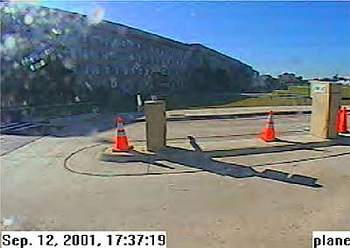
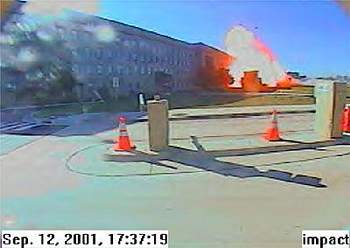
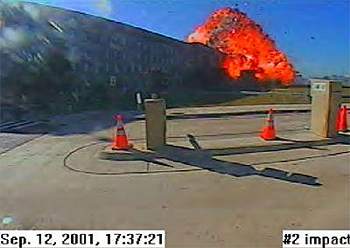
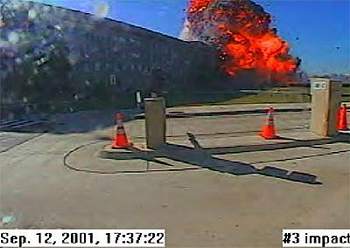
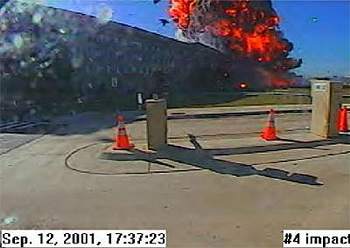
There are any number of curious anomalies in these images, perhaps the most obvious of which is the fact that the date/time stamps, added after the fact, are off by about thirty-two hours. The second frame differs from the other four in a number of ways: it is brighter, shifted slightly to the left, and obscured in both upper corners. The second frame also has the same time stamp, 17:37:19, as the first frame, though it obviously wasn't taken at the same time.
Some researchers, by the way, have claimed that the time stamps indicate a tape speed of 100 frames per second, which these same researchers have noted is extremely unlikely. These people apparently never learned how to tell time, so let me clue them in: the difference between 17:37:22 and 17:37:23 is one second, not 1/100 of a second. Time, you see, is generally recorded as hours:minutes:seconds. But no one should let that stop them from making stupid claims that further discredit the field of 9-11 research.
Another curious feature of the images can be observed by focusing your attention on the upper left corner of each frame -- the area where it looks like Bob Guccione snuck by and spread a little Vaseline on the camera lens. As can be clearly seen, the pattern of condensation drops (or whatever they are) is quite consistent in frames #1, #4, and #5, but much different in frames #2 and #3, as though the drops began to disperse and then inexplicably returned to their original configuration. Another curiosity is that the helicopter support structure that can be seen in silhouette in front of the fireball in frames #3 and #4 is incongruously painted a bright orange in frame #2.
What then are we to make of these images? Only one of the five purportedly shows an airplane about to crash, and it is of such poor quality that it is not possible to perform any sort of meaningful analysis. There is little question that the images have been manipulated in various ways, rendering them all but useless for shedding any light on what happened at the Pentagon on September 11, 2001. The most likely scenario is that these doctored photos were 'leaked' quite deliberately for the express purpose of further muddying the waters. We will therefore treat these images with the respect that they deserve -- which is to say, we will pretty much ignore them.
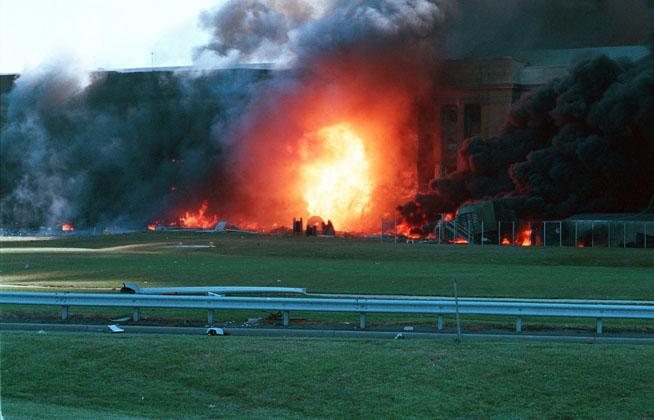
 Unlike
the actual 'crash,' there is plenty of photographic evidence of the
aftermath of
the attack. Virtually none of it supports the official story.
Nothing that can be confirmed as aircraft
debris
is visible in any of the photographs that have found their way into the
public domain. Photos do reveal, and Pentagon officials have
acknowledged, that the
initial penetration into the side of the building was not nearly large
enough
to account for the wingspan of a Boeing 757-200 aircraft (actually, the
penetration
wasn't even large enough to account for the fuselage of a 757). In
fact, all the available photos
reveal that the initial damage to the front facade of the Pentagon,
after the alleged crash but before the collapse that occurred about a
half-hour later, was relatively minor. And the impact apparently did
not generate enough explosive
force to even displace the wire spools just below the alleged point of
impact.
Unlike
the actual 'crash,' there is plenty of photographic evidence of the
aftermath of
the attack. Virtually none of it supports the official story.
Nothing that can be confirmed as aircraft
debris
is visible in any of the photographs that have found their way into the
public domain. Photos do reveal, and Pentagon officials have
acknowledged, that the
initial penetration into the side of the building was not nearly large
enough
to account for the wingspan of a Boeing 757-200 aircraft (actually, the
penetration
wasn't even large enough to account for the fuselage of a 757). In
fact, all the available photos
reveal that the initial damage to the front facade of the Pentagon,
after the alleged crash but before the collapse that occurred about a
half-hour later, was relatively minor. And the impact apparently did
not generate enough explosive
force to even displace the wire spools just below the alleged point of
impact.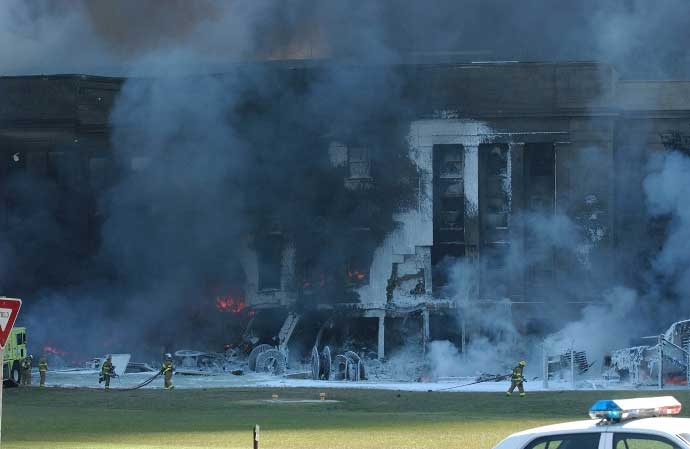 The pre-collapse photos reveal that
the front wall
of the Pentagon remained remarkably intact after the initial impact.
Pentagon officials, and defenders of the official story, have claimed
that
the small entry
wound made by the alleged plane was the result of the fact that the
aircraft's
wings
were
either sheared off or folded back on impact, and that only the fuselage
entered the building
-- becoming, in effect, a very large missile. That would be a
much more plausible claim if a 757 did
not have very large
wings that would be clearly visible in these photographs if
they had in fact been sheared off as the fuselage entered the building.
Attached to those wings are two engines, each about 9 feet in
diameter, 21 feet
long, and weighing nearly five tons. The official
story doesn't really bother to account for them.
The pre-collapse photos reveal that
the front wall
of the Pentagon remained remarkably intact after the initial impact.
Pentagon officials, and defenders of the official story, have claimed
that
the small entry
wound made by the alleged plane was the result of the fact that the
aircraft's
wings
were
either sheared off or folded back on impact, and that only the fuselage
entered the building
-- becoming, in effect, a very large missile. That would be a
much more plausible claim if a 757 did
not have very large
wings that would be clearly visible in these photographs if
they had in fact been sheared off as the fuselage entered the building.
Attached to those wings are two engines, each about 9 feet in
diameter, 21 feet
long, and weighing nearly five tons. The official
story doesn't really bother to account for them.One enterprising soul put together a composite image that illustrates, more clearly than any other image that I have come across, the fundamental absurdity of the official story of the crash of Flight 77. Seen below is an actual photo of the Pentagon, over which is overlaid both a properly scaled image of the pre-collapse damage to the facade on September 11, and a properly scaled image of a Boeing 757-200 aircraft.
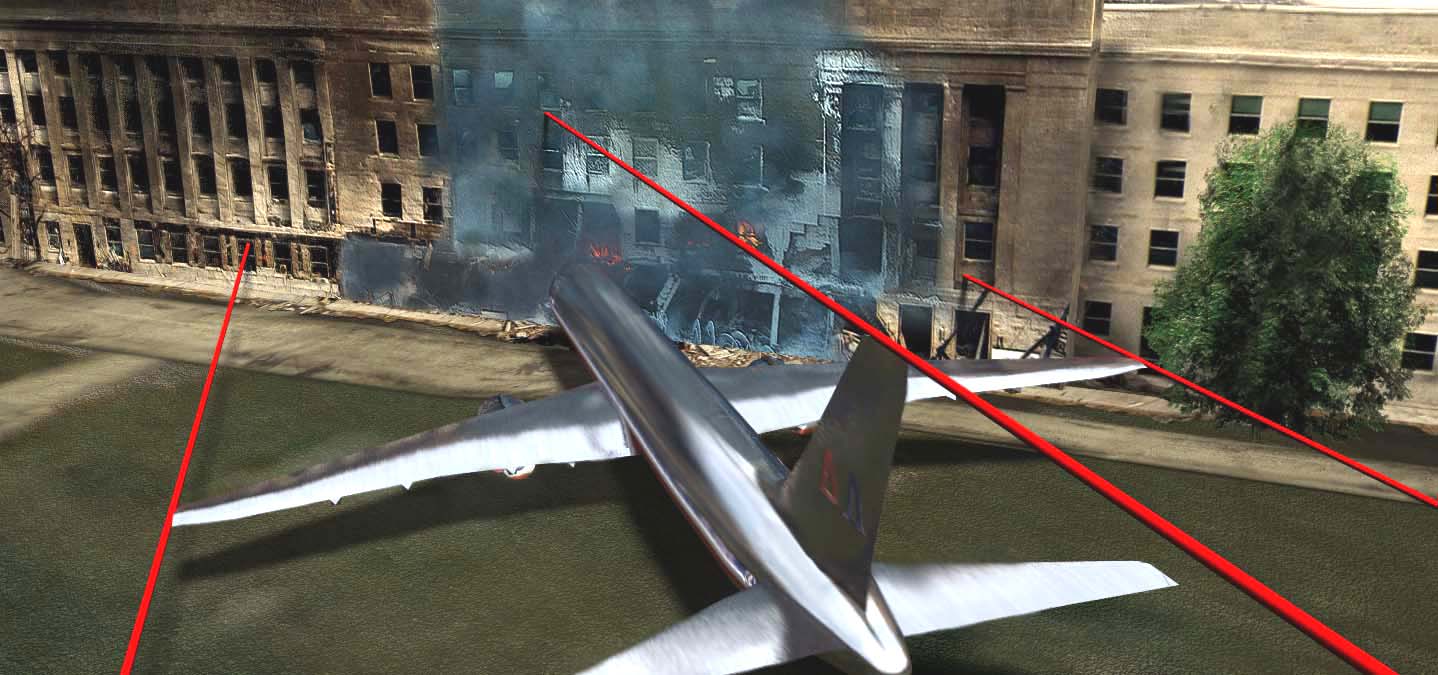
Perfectly obvious in this composite photo is that the actual impact damage to the Pentagon was entirely inconsistent with the crash of a large passenger plane. Also obvious is that even if we accept the dubious notion that the plane's fuselage disappeared within the building, some very large aircraft parts seem to be unaccounted for -- like the two wings, the two engines, and the three tail fins.
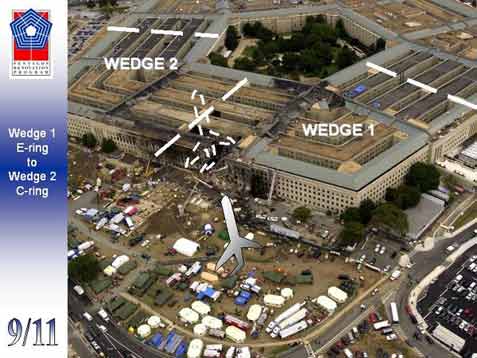
 Nevertheless,
the official story claims that the plane did in fact impact the
Pentagon exactly as depicted in the above photo, as can be seen in the
graphic to the right, which was used by Pentagon spokesmen during a
post-911 press briefing. As can be seen in the graphic, Flight 77
allegedly plowed through three of the five concentric rings that make
up the Pentagon, coming to rest completely within the complex of
buildings.
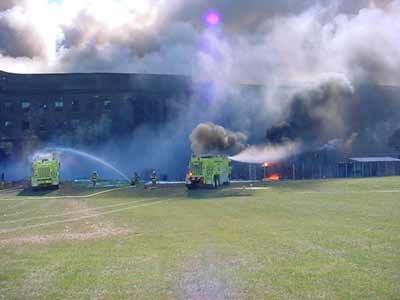
According to various 911 gatekeepers, that is why there is no aircraft
debris visible on the lawn outside the alleged point of impact (such as
in the photo to the left). Also missing, needless to say, is any
indication that a 100 ton aircraft performed a gymnastics floor routine
on that lawn before slamming into the side of the Pentagon.
Nevertheless,
the official story claims that the plane did in fact impact the
Pentagon exactly as depicted in the above photo, as can be seen in the
graphic to the right, which was used by Pentagon spokesmen during a
post-911 press briefing. As can be seen in the graphic, Flight 77
allegedly plowed through three of the five concentric rings that make
up the Pentagon, coming to rest completely within the complex of
buildings.
According to various 911 gatekeepers, that is why there is no aircraft
debris visible on the lawn outside the alleged point of impact (such as
in the photo to the left). Also missing, needless to say, is any
indication that a 100 ton aircraft performed a gymnastics floor routine
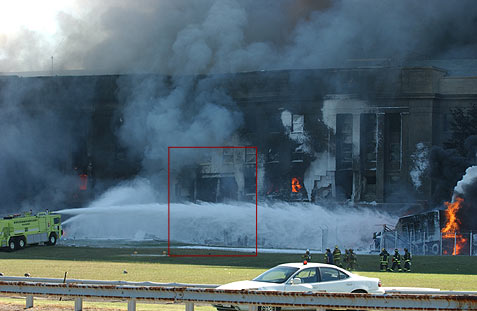
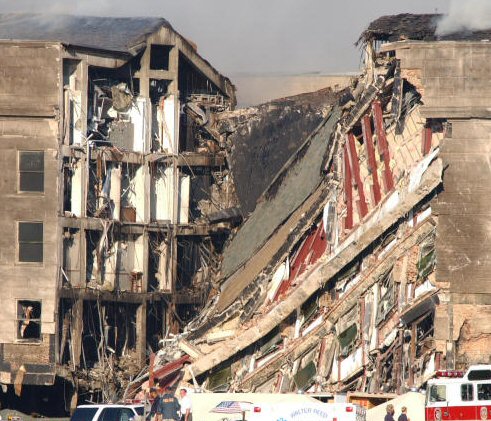
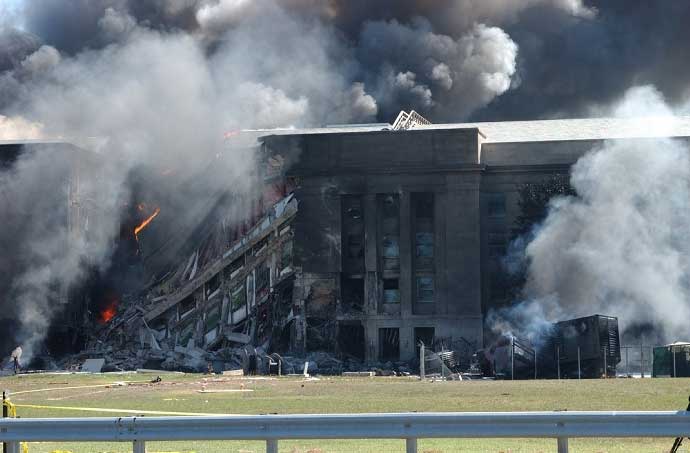
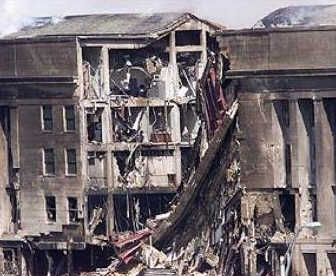
on that lawn before slamming into the side of the Pentagon.After the collapse, there was still no aircraft wreckage visible, as can be seen in these post-collapse photos -- the center one taken just after the collapse, while the fire still burned, and the other two taken after clean-up efforts were underway. According to the 911 gatekeepers, the remains of the aircraft were at that time still buried beneath the collapsed building. Fair enough. That seems to be a reasonable enough claim -- except for the fact that only the outer ring of the Pentagon collapsed, while the plane, according to the official story, penetrated through two additional rings, neither of which collapsed, and neither of which yielded any verifiable aircraft debris. And if any aircraft debris was later found buried beneath the collapsed portion of the Pentagon, no one bothered to document it with photographs.
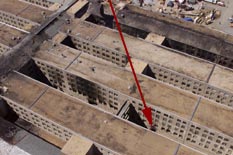
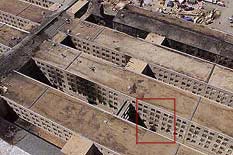 Sometimes offered in support of the official
story is
photographic evidence of an exit wound exactly where we would expect it
to be located if an airplane, or some other fast moving projectile, did
in fact
slice
through the concentric rings of the Pentagon in the manner indicated in
the official Pentagon graphic. Punched through the inside of "C" ring,
at ground level, was a remarkably clean hole that appeared to measure
roughly 8'-9' high and 10'-12' wide. This hole, punched through a
thick,
steel-reinforced masonry wall, was purportedly made by the
nosecone of Flight 77. There is no indication, however, in any of the
photos, of aircraft debris either inside or outside of the hole.
Sometimes offered in support of the official
story is
photographic evidence of an exit wound exactly where we would expect it
to be located if an airplane, or some other fast moving projectile, did
in fact
slice
through the concentric rings of the Pentagon in the manner indicated in
the official Pentagon graphic. Punched through the inside of "C" ring,
at ground level, was a remarkably clean hole that appeared to measure
roughly 8'-9' high and 10'-12' wide. This hole, punched through a
thick,
steel-reinforced masonry wall, was purportedly made by the
nosecone of Flight 77. There is no indication, however, in any of the
photos, of aircraft debris either inside or outside of the hole.